

This paper was part of a public seminar, What Music Tells Us about Life, Love, Ourselves — A Celebration! at the not-for-profit Aesthetic Realism Foundation in New York City.
Aesthetic Realism is the philosophy founded in 1941 by Eli Siegel, based on this principle: “All beauty is a making one of opposites and the making one of opposites is what we are going after in ourselves.” In this seminar, students in the Opposites in Music Class, taught by Barbara Allen and Edward Green, discussed wonderfully diverse instances of music: the Temptation’s “My Girl,” an Irish ballad and works by Wagner, Bach, Benny Goodman — and showed these important facts: that art is the oneness of reality’s opposites — and every successful musical composition shows this and the answers to the biggest questions of life are in the technique of music.
I believe this question by Eli Siegel from his 1955 broadside, “Is Beauty the Making One of Opposites?” explains why the song “My Girl” by the Temptations has pleased people so much:
Simplicity and Complexity: Is there a simplicity in all art, a deep naivete, an immediate self-containedness, accompanied perhaps by fresh directness or startling economy? — and is there that, so rich, it cannot be summed up; something subterranean and intricate, counteracting and completing simplicity; the teasing complexity of reality meditated on?
For years since it became a huge hit record in 1964, I thought of “My Girl” as a simple, likable enough song and took it for granted. But studying it further, I have been moved by the way simplicity and complexity are made one in it.
Sung by the Temptations and written and co-produced (along with Ronald White) by — in my opinion, one of the true artists of American song — Smokey Robinson — “My Girl” begins with a very simple three-note phrase on the bass guitar accompanied by light taps on a snare drum. The first note is on the fifth of the scale, then there is a drop down to the tonic on the next two notes. And, with rests in between, the phrase keeps repeating. There is complexity even here, as the drop from fifth to tonic occurs on the strong first and third beats of each measure. This makes for a sound that is both lopsided and right, and that resembles the sound of a heart beating.
Then a guitar plays a bright series of notes that climbs up the open pentatonic scale, drops to where it began, and climbs up again in a kind of circular motion — and there is simplicity to this pattern. At the same time, very precise finger-snaps can be heard on the second and fourth beats of each measure.
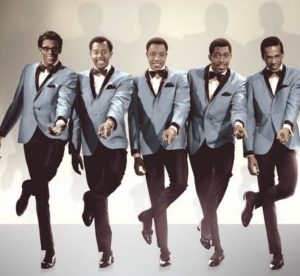
These simple finger-snaps become the pulse of the whole song. There is a straightforward, open quality to this pulse — sort of casual and easy-going — amidst all the syncopating rhythms and rising and fallings. With all the further richness and complexity yet to come, the song never loses this simple feeling of just sort of swinging on a swing out in the warm Spring air.
There is “a fresh directness” and “startling economy” in the way the verse begins. Drums and voice boldly come forth together as lead singer David Ruffin sings, “I’ve got sunshine on a cloudy day.” And that word “sunshine” sounds like what it means: it bursts forth on the bright major third of the scale, directly on the downbeat and then spreads out across a whole measure. And that swinging rhythm begun by the finger-snaps is now added to by short, bright guitar chords. As the voices of the other Temptations enter — first the deep bass of Melvin Franklin descending on “do-do-do,” then joined by all the voices on a richly harmonized “oo”—there is, as Eli Siegel said, “something subterranean and intricate” accompanying the simplicity of Ruffin’s “When it’s cold outside, I’ve got the month of May.” The overall effect of this opening section is very pleasing. In just 25 seconds, many different things have been added together, yet within all the complexity, there is still that simple, easy-going rhythm underneath.
As the Temptations sing with that simple forthrightness, “I guess you’d say/What can make me feel this way,” the horns follow the vocal harmony. Perhaps there is something a little too predictable, even a touch complacent in this aspect of the arrangement which repeats several times. As a man, I know how quickly an excited, grateful feeling can change to self-congratulation: “She likes me! Hooray for me! She’s my girl!” A man can get to a fake simplicity, and preen himself on having this girl; she chose me and I’m perfect!
Once, in an Aesthetic Realism consultation I was asked, “Do you have a tendency, as soon as a woman shows you the least bit of approval, to translate it into total approval?” My answer was yes — and I have seen that this made me feel I couldn’t have love in my life; and was not what I really wanted!
The words of “My Girl” have a taking simplicity. They sing:
I’ve got so much honey the bees envy me.
I’ve got a sweeter song than the birds in the trees.
I don’t need no money, fortune or fame.
I’ve got all the riches one man can claim.
I feel these words are getting at something big. In Self and World, Eli Siegel writes about a man’s feelings about a woman:
What is that for which the self or body of Edith Ritchie stands? Where are the boundaries of the thing represented in Jim’s mind by this one person? Does it end with a state or a country or a family or an ocean or even the sky? There is no ending in Jim’s mind of the thing represented by Edith, for she stands for everything.
I think “My Girl” has something corresponding to the feeling Mr. Siegel describes, in what this man is singing, in the grateful fullness of sound–which includes a whole section of strings — at the point in the refrain where “My Girl” is sung and also later as instruments and voices come into full bloom in the bridge. Aesthetic Realism scientifically provides the means to do what this song hints at: to feel through another person that the whole world looks good to you. I am one of the luckiest men alive to be learning about this in my marriage to the woman I love, Carol McCluer, and as the father of our daughter Sara.
I used to think I just longed for everything to be simple; and I also felt that I was the one complex thing in the world, and everyone else was simple, dull, and flat. This was contempt, and I learned it is why I would alternate between deadly boredom and frantic agitation.
I am learning now in, classes taught by Ellen Reiss, Aesthetic Realism Chair of Education, about the urgent necessity for good will between two people. Good will has simplicity — it is the simple desire for another person to fare well. And it also takes in wanting to know the rich depths of a person in all her nuances — and having a great time doing so! As my wife and I talk, walk together down a street, and as I hold her in my arms, I know that she stands for a world I was born to know and care for — and I am filled with a sweet and powerful feeling that makes me proud!
I have seen that when we are true to our deepest purpose — to like the world — there is something straight line, simple about it. And yet it brings to a person the unmatched pleasure of knowing you are in a large, diverse world you are infinitely related to.
It happens that Motown Records released a recording of “My Girl” with orchestral accompaniment, and also another version isolating the track of the Temptations alone — just their voices and one of them snapping his fingers. In the Opposites in Music Class, we listened to this and were thrilled to see that in its spareness, it has another relation of the simple and complex. You hear more of the subtleties of David Ruffin’s voice, and the beautifully blended harmonies of the other singers. His voice has a very fine relation of smoothness and roughness. There is “startling economy” and also “something, so rich, it cannot be summed up” — what a man needs to feel as he thinks about a woman. What Aesthetic Realism can teach every man and woman about the relation of art to life and love is beautiful, practical and so needed. And this is a wonderful year for people to meet it!
Kevin Fennell, a singer, and his wife, actress Carol McCluer, are studying to teach Aesthetic Realism in classes taught by Ellen Reiss.