

The thrilling photography exhibition now at the Terrain Gallery in New York City runs through the first week of February, 2000. The gallery is part of the Aesthetic Realism Foundation, the not-for-profit educational foundation at 141 Greene Street (off West Houston) in Manhattan’s SoHo district.
Three photographers—Louis Dienes, David Bernstein, and Len Bernstein—show black-and-white and color photographs, and write with gratitude of the value of their study of Aesthetic Realism to each of them as photographers and in their lives. The American poet and educator Eli Siegel, founder of the philosophy Aesthetic Realism, stated, “The world, art and self explain each other: each is the aesthetic oneness of opposites.” And in the announcement for this exhibition, his 1951 lecture Aesthetic Realism As Beauty: Photography is quoted, in which he said:
The photograph is a big event in the history of the relation of the perception of self to objects….Photography does dramatize light and shade, softness and sharpness, foreground and background; does dramatize where drama is: that is, in the surfaces, the depths, the relations of things….Photography is the history of how exactitude changes into meaning.
Louis Dienes shows the dramatic contrast of dark and light in grasses growing from a crack in the sidewalk, and in another photograph, in subtle tones of gray, a couple walking on a beach; Len Bernstein has a meditative woman reading in a doorway and an eager boxer dog at a window; David Bernstein has color abstractions—a car’s gas-cap, and, so different, lively celebrants at the West Indian Day Parade. The artists comment on their intention and what they have learned from Aesthetic Realism about the tremendous value of seeing opposites in things, in themselves, and in the technique of photography: personal and impersonal, dark and light, universe and object. Aesthetic Realism is the study of how the everyday world we live in, including our selves, is the material of art.
The exhibition includes a portfolio of photographs by Louis Dienes that inspired his poem, Black and White, which begins:
The day black and white got a break
Was the day he and she and they
Thought of those things black and white could convey,
That is, those things could be turned into black and white
And be clear to minds.
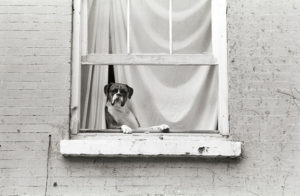
by Len Bernstein
Every Saturday afternoon at 2:30 p.m., there are short talks from the historic series presented free to the public for over 15 years, The Aesthetic Realism of Eli Siegel Shows How Art Answers the Questions of Your Life! For further information you may contact the Aesthetic Realism Foundation at (212) 777-4490; www.AestheticRealism.org.
“I was thrilled when I saw this dog who seemed to be the occupant of the apartment, self-confidently at its windowsill, gazing at us with a fine, appraising look. I saw in him a roughness and a solidity, like the worn brick and wood of the outside of the building.”
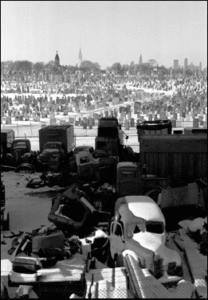
by Louis Dienes
“The Auto Graveyard was a picture I came to on a winter day just cold enough to keep the snow from melting…Looking at [it], Eli Siegel said: ‘The brokenness of the cars and the purity of the snow are brought together by the light. There is a relation, too, between the discarded autos and the cemetery in the background. Brokenness and regularity, coldness and warmth are one.’ To see these opposites…reconciled, is to see the world making sense or having meaning, and my gratitude to Mr. Siegel for showing that it does is the same as my heartbeat.”