

As the holidays approach, people everywhere are worried about money—despite what so-called “experts” call a robust economy—and are in turmoil about how to show kindness. I’m glad to describe here what I’ve learned from Aesthetic Realism. It shows what real kindness is and enables a person to learn how to have it! This knowledge is the greatest gift anyone can get.
Aesthetic Realism is based on these principles: 1) “The deepest desire of every person, is to like the world on an honest basis”—all kindness arises from this desire; and 2) “There is a disposition in every person to think he will be for himself by making less of the outside world”-this is contempt, the source of all unkindness and cruelty.
I hoped to be kind, but was ashamed about how I was with people. I could act as though I were interested in a person, look attentive as someone spoke, be “considerate,” but I felt that people were fools and I was a fake. Then at age 28, when I began to study Aesthetic Realism, I learned about my desire for contempt, my thinking that the way I’d please myself was by managing people, beating them out. I felt what I thought I’d never feel—”I can really be kind, have sincere feeling and be proud of my effect on people!”
In Definitions and Comment, Mr. Siegel defines kindness as “that in a self which wants other things to be rightly pleased.” This means encouraging that person to like the world.
As a teenager, I wanted to please people. If grandma had to be driven to church or picked up, just call me! If my uncle needed help painting his apartment, I’d be there. Yet in the comment to his definition Mr. Siegel explains:
To be kind is honestly to think of what another person, or other persons, truly desire. If we do not take the trouble to find this out, or do not want to take the trouble, our ‘kindness,’ is so much not kindness.
What does a person truly desire? What would please that person rightly? I didn’t even know these questions existed. I was more interested in impressing people, having them see me as “caring,” “warm,” and not like other people who were cold and didn’t give a damn! If a man or woman smiled at me and seemed happy, I thought that meant I was being kind. But with all the approval I got, I felt more and more distant from people.
As a child, I saw my mother go back and forth between liveliness and sadness. She enjoyed being in the midst of bustling activity at her job, but at home she often looked sad. That is, until she saw me and my sad, “understanding” look. Then she would brighten up and seem happier. Who my mother was, what she felt and hoped for, that she had an inner life at all, was not real to me. In my conceit, I wanted to think the thing she needed to be happy was ME.
This, I learned, is how I wanted to see all people, particularly women, and that this way of seeing people made it impossible for me to be kind.
I saw that what I thought was kindness and love was really hate for who a woman was: it was wanting her to be weak so she would need me. Inevitably, every relationship I had ended in anger and disappointment, with my feeling harder and more bitter inside. Mr. Siegel explained:
If there is a bad effect what would it be? Do you think you excessively want to console a woman? The desire to console is in the world of good and evil. In the human being there is a tremendous desire to save another person.
I said, “I have a history of trying to save women.” And he continued, “You take it for granted that people are suffering and that you can alleviate the suffering. You see it as valuable. If you alleviate the suffering of someone, do you respect her for it?” I answered no. I saw her as being taken in by me and thought she was stupid.
As Mr. Siegel spoke to me in Aesthetic Realism lessons, I had the joy, new to humanity, of feeling at last someone saw through my facade and understood what tormented me. He said:
To put on a show of kindness and usefulness and not respect the person when you are successful, is very dangerous. It is the thing that you like least about yourself.
What I’ve learned has given me great happiness—including in my marriage to Maureen Butler—and the self-respect I thought I’d never have. I’m proud that I want to be kind to Maureen, so that through me she is closer to the whole world. And I love her for encouraging me to be deeper, to have more feeling for all people. My life is a success because through what I’ve learned I’m able to have a good effect on others, including the men I have the honor to teach in Aesthetic Realism consultations.
Aesthetic Realism Consultations
Consultations are based on the over 35,000 Aesthetic Realism lessons taught by Eli Siegel, and take place in person and by long distance telephone from the not-for-profit Aesthetic Realism Foundation in New York City. Individual men, women and children study with a trio of consultants how the answers to the deepest questions of life are in the principles of Aesthetic Realism, enabling people to change in ways they always hoped for.
For example, in one consultation John Parker told us he was tremendously affected that his parents were separating after many years of marriage. He said self-critically, “I should be more understanding. I shouldn’t be so quick to make judgments and get angry.” “What do you think stops you?” his consultants asked. “I don’t like thinking about people enough,” he answered.
Our purpose was to have Mr. Parker respect himself by thinking deeply about their feelings and also about the feelings of his 10-year-old brother George. He told us about an incident which troubled him. He and his wife had taken George to an amusement park and though Mr. Parker felt they had a “wonderful time,” George complained a lot. While he was very critical of George, he wasn’t sure that he was kind.
We asked: “Did you feel you could have been more understanding?” “Yes,” he answered.
Consultants. Did he feel the amusement park was in the same world as his confusion about his mother and father, or was it some respite, some escape?
Mr. Parker. I think it might have been some respite. I see what you’re saying.
Consultants. Did you have in mind, How can we use this trip to understand our parents more?
Mr. Parker. No, I didn’t. I see.
Consultants. Most people don’t think understanding another is a real good time and is the same as taking care of themselves. Didn’t you feel George was supposed to smile, like every minute, and praise you for taking him?
Mr. Parker laughed and said “Right!”
John Parker represents men everywhere, hoping to be kind and desperate to know what stops them. The criticism of Aesthetic Realism is the kindest thing we can hear because it enables us to change, to be increasingly kinder. This is the education I have the great good fortune to continue studying now in classes taught by Ellen Reiss, the Aesthetic Realism Chairman of Education.
The big thing that stops men from being kind is contempt. A form it can take is thinking we are smart and strong in being displeased with the world. In a class I learned from Miss Reiss how this was in me. My wife mentioned my tendency to be irritated if I didn’t understand something right away, for example, if I couldn’t figure out how to record music on our new CD player, or if Maureen asked me a question which I saw as interrupting my line of thought.
Miss Reiss encouraged me to be deeper, to see good nature as strong, intellectual, practical. She said, “You should have a certain sweet quality of, ‘There’s more for me to see, and I’m going to see it!'” Through this discussion, I decided to study good nature and kindness in literature, which led me to a great 19th century English novelist.
Kindness, Good Nature, and Charles Dickens
Charles Dickens (1812-1870) is one of the kindest people in history. The reason is explained by Mr. Siegel in his lecture, “Imagination Has Emphasis”:
The thing that we see in Dickens—and those persons who want to find out what liking the world means have to see what Dickens is saying—is that the need to like the world is tremendous in him; it’s insistent.
Dickens was a fierce critic of the contempt and brutality of profit economics—seeing people in terms of how much money can be made from their labor and how little they can be paid. Said Mr. Siegel, “Dickens himself is a study in determination and kindness. He was steel and tears.”
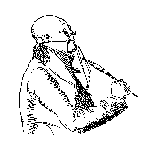 A character who is loved for these qualities is Wilkins Micawber in David Copperfield. Mr. Micawber, his wife Emma and 4 children are poor, and what they endure is the agony many people in America and the Philippines are enduring right now! To make ends meet he is forced to borrow money, pawn their belongings, and constantly buy on credit which he cannot repay. At one point he is sent to debtor’s prison.
But despite these adversities, which can plummet him into despair, unlike many people he doesn’t use what he endures to hate the world or to be mean. His desire to be honestly pleased and to have others be, springs forth with courage, charm and utterness. He was, said Dickens, “a thoroughly good-natured man.”
For example, to Mr. Micawber’s grief and mortification, creditors yell up at his window demanding payment, “But,” writes Dickens, “within half an hour afterwards, he would polish up his shoes with extraordinary pains, and go out, humming a tune with a greater air of gentility than ever.”
His good nature is the same as his passion for justice and feeling for people. In debtor’s prison he works on a petition to the government to end imprisonment for debt. Writes Dickens:
Mr. Micawber (who was…never so happy as when he was busy about something that could never be of any profit to him) set to work at the petition…and appointed a time for all…if they chose, to come up to his room and sign it.
Mr. Micawber has graciousness and kindness in the midst of worry. The way he talks to Emma has sweetness and thoughtfulness that are also strong, energetic, hearty. While she is dear to him, other people are too and he is critical of himself for irritability or discontent. He is upset when water to their home is cut off because he can’t pay the water bill. But soon he is making a bowl of punch and Dickens writes: “His recent despondency…was gone in a moment…[and] it was wonderful to see his face shining at us.”
What Dickens is saying through Micawber, which Aesthetic Realism makes clear, is of tremendous importance now as so many people are in agony about money, unable to provide even the bare necessities for their families because they can’t get decent paying jobs. To be kind a man has to be accurate about the cause of this brutal unkindness. In the international periodical, The Right of Aesthetic Realism to Be Known Ellen Reiss explains:
A cruel economy, which is causing so much pain to people, is not the same as the world—in fact is unfair to the world. And therefore to be against it, even furious with it, should not mean being against the world itself. It is human contempt, not reality, which has decreed that you can have a job, or rent an apartment, only if someone can make big profit from you.
Miss Reiss states that real kindness is “to oppose what is unjust in a person out of respect for that person; to be terrifically against what is ugly in the world out of love for that world.”
This we see in Mr. Micawber who, desperate for work, accepts a job offered by Uriah Heep, one of the memorable villains in fiction. Heep exemplifies the contempt Mr. Siegel so kindly criticized in me—”the putting on a show of ‘kindness’ and ‘usefulness'” while secretly manipulating people. Micawber is pivotal in exposing and defeating Heep’s ruthlessness, and it is thrilling to see good nature at one with fierce determination to have others rightly pleased.
The kindness that the world is desperate for is in the study of Aesthetic Realism. As this education becomes known, people everywhere will meet their greatest friend, Eli Siegel, the man whose understanding of the human mind—including what makes us cruel—has given humanity the knowledge that will make the world truly kind!
Ernest DeFilippis is a consultant on the faculty of the Aesthetic Realism Foundation, a not-for-profit educational foundation at 141 Greene St., New York, NY 10012, (212) 777-4490; www.AestheticRealism.org. Some papers he has given in public seminars at the Foundation are, “Is Love Owning or Knowing?” “Why Are We Against Ourselves?” “Contempt, Regret and Vietnam,” “Can a Man Be Proud of His Purpose in Sex?”